
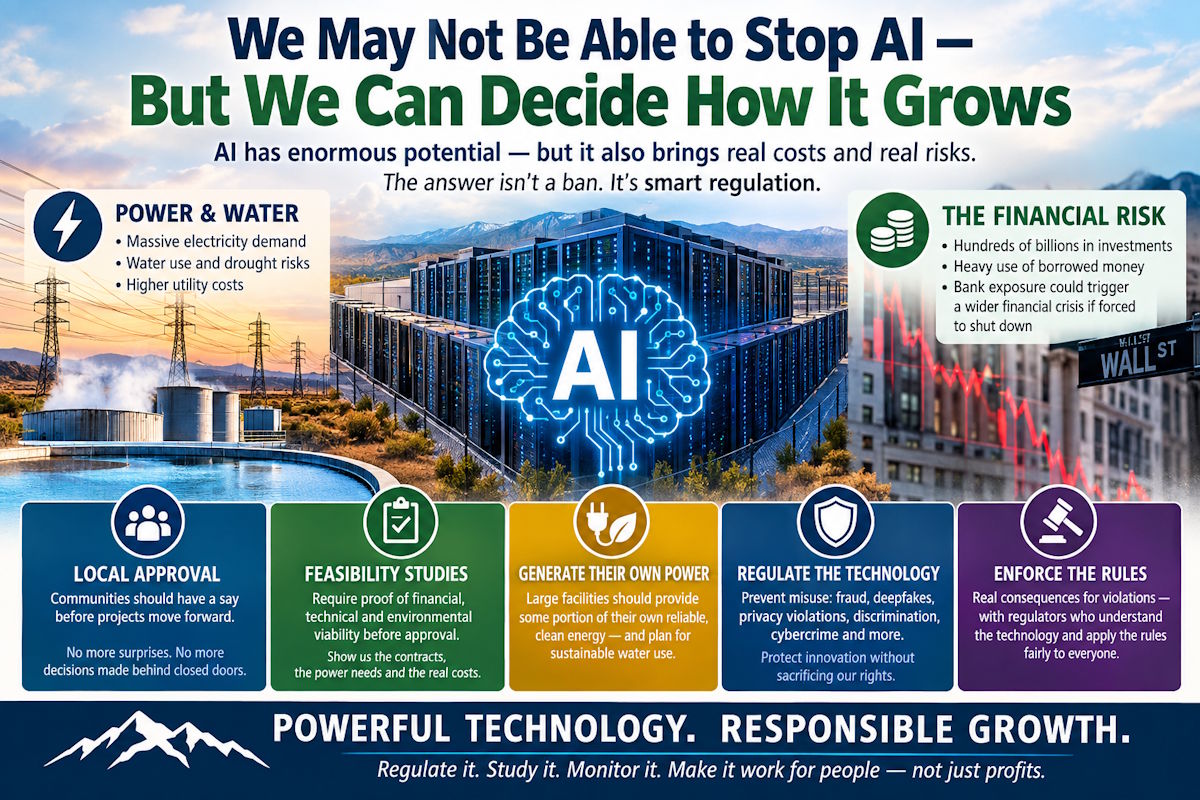
We May Not Be Able to Stop AI — But We Can Decide How It Grows
by A New Mexico Resident
There is a growing public backlash against artificial intelligence, and it is not difficult to understand why.
People are watching enormous data centers being proposed and built in their communities. They hear about the tremendous amounts of electricity required to operate them. They worry about water consumption, noise, land use, environmental effects and the possibility that ordinary consumers could end up paying higher utility bills to provide the infrastructure these facilities require.
And then there is the technology itself.
Some people simply don’t trust artificial intelligence. Others are concerned about job displacement, misinformation, surveillance, political manipulation, privacy and the possibility that AI could be used in ways that harm individuals or society.
For some, the answer is simple: Stop it. Ban AI and stop building the data centers that make it possible.
I understand the frustration behind that argument. But I don’t believe a nationwide ban on artificial intelligence is either realistic or necessarily the best answer.
The reality is that we have already crossed a technological threshold.
AI is no longer a laboratory experiment that can simply be put back on the shelf. It is being incorporated into businesses, government, medicine, education, communications, manufacturing, transportation, scientific research and countless other areas of life. Billions of dollars have already been invested in the technology and the infrastructure supporting it.
And increasingly, much of that investment is financed with borrowed money.
There is a financial issue we cannot ignore
The enormous construction boom surrounding AI has created an enormous financial commitment.
The Federal Reserve Bank of Chicago recently examined the potential “tail risk” to banks from their exposure to AI-related industries. It found that large banks had approximately $450 billion in commitments to AI-adjacent industries in late 2025, with about $150 billion outstanding. The Chicago Fed also specifically identified financing for data centers as one of the channels through which banks are exposed to the AI boom.
The Bank of England has also warned about the rapidly expanding debt financing of AI infrastructure. Its July 2026 financial stability report noted that more than half of some projected external data-center financing could come through debt, while private credit and other financing structures are becoming increasingly important.
And this isn’t simply a theoretical concern.
Major technology companies are committing hundreds of billions of dollars to infrastructure. J.P. Morgan estimates that hyperscaler capital expenditures could reach $697 billion in 2026 alone, while noting that power availability, permitting and other infrastructure constraints are becoming major obstacles.
That means the question of AI regulation isn’t occurring in a vacuum.
If government suddenly prohibited large portions of AI development or forced major data centers to close, the consequences wouldn’t necessarily stop at the technology companies. The financial consequences could extend to construction companies, utilities, equipment manufacturers, private-credit funds, investors and banks.
That doesn’t mean government should protect companies from bad investments.
It does mean policymakers need to understand that an abrupt attempt to shut down the AI industry could create economic consequences far beyond Silicon Valley.
The Chicago Fed itself has warned about the possibility of stress spreading among interconnected AI-related industries if demand or investment suddenly falls.
But protecting the financial system doesn’t mean giving AI a free pass
This is where I believe we need to find a sensible middle ground.
We shouldn’t respond to legitimate public concerns by saying, “Don’t worry about it. The technology companies know what they’re doing.”
At the same time, we shouldn’t respond to legitimate concerns by saying, “Ban everything.”
Regulation is the middle ground.
And regulation doesn’t have to mean government controlling the technology itself.
It can mean establishing reasonable rules about where, when and under what conditions massive AI infrastructure can be built.
Local communities should have a voice
A community shouldn’t discover that a gigantic data center is going to consume enormous amounts of electricity and potentially millions of gallons of water only after the project has already been approved.
Before construction begins, the public should know:
- How much electricity will the facility require?
- Where will that electricity come from?
- Will additional power plants or transmission lines be required?
- Who will pay for those improvements?
- How much water will the facility consume?
- Where will that water come from?
- What happens during drought conditions?
- What will happen to local utility rates?
- What are the noise and environmental impacts?
- How many permanent jobs will actually be created?
- What tax benefits will the community receive?
- What happens if the facility becomes economically obsolete?
- Who pays for decommissioning if the project fails?
Those aren’t unreasonable questions.
They are the same kinds of questions we should ask about any major industrial development.
And there is already evidence that communities are demanding exactly this kind of oversight. Reuters recently reported that lenders themselves are increasingly examining community approval and regulatory readiness before financing data-center projects.
That tells us something important.
Local approval isn’t necessarily an enemy of economic development. It can actually make development more financially responsible.
Feasibility studies should come before promises
One of the biggest problems with the current data-center boom is that projected demand can get far ahead of actual infrastructure.
Texas recently responded to an extraordinary surge in data-center power requests by examining whether all of those requests were actually legitimate and financially viable. Reuters reported that requests exceeded 700 gigawatts—more than ten times the estimated current electricity consumption of all U.S. data centers—and described concerns about so-called “ghost demand.”
That is exactly why feasibility studies make sense.
Before a community commits its water, electrical capacity, roads and other infrastructure to a gigantic facility, there should be evidence that the project is financially and technically viable.
A company shouldn’t be able to reserve enormous amounts of scarce electrical capacity simply because it has filed an ambitious proposal.
Show us the financing. Show us the contracts. Show us the projected electricity requirements. Show us the water requirements. Show us the environmental impact. Show us who is going to pay.
Then let the public and regulators make an informed decision.
And perhaps data centers should generate more of their own power
Here’s another idea worth serious consideration.
If an AI data center requires an extraordinary amount of electricity, perhaps the answer shouldn’t always be to make the surrounding community’s electrical grid carry the entire burden.
Large facilities could increasingly be required to provide some portion of their own dependable power.
That could mean dedicated generation, long-term power purchase agreements, renewable generation combined with storage, or other technologies appropriate to the location.
The precise solution shouldn’t necessarily be dictated by politicians. But the principle is reasonable:
If you are going to build an extraordinary electricity-consuming industrial facility, you should bear an appropriate share of the cost of providing the extraordinary amount of electricity you consume.
The same principle can apply to water.
If a facility requires substantial water for cooling, developers should have to demonstrate that the water supply is sustainable and that local residents and existing businesses aren’t being placed at unacceptable risk.
We also need to regulate what AI does
The infrastructure issue is only half the problem.
The other half is the technology itself.
Artificial intelligence can be enormously beneficial, but powerful technology can also be abused.
We need enforceable rules concerning things such as:
- Fraud and impersonation
- Deepfakes and deceptive political content
- Identity theft
- Unauthorized use of private information
- Automated discrimination
- Manipulation of elections and voters
- Consumer deception
- Copyright and intellectual-property abuses
- Cybercrime
- The use of AI to facilitate criminal activity
- Transparency when people are interacting with AI rather than a human
But regulation must be carefully written.
We don’t want government using “AI safety” as an excuse to censor legitimate political speech, suppress criticism of government or control what citizens are allowed to say or think.
There is an important constitutional principle here:
Regulating the misuse of technology is not the same thing as regulating people’s thoughts, opinions or constitutionally protected speech.
The government should be extremely careful about crossing that line.
There needs to be somebody capable of enforcing the rules
Another mistake would be to create a beautiful set of regulations that nobody has the authority or resources to enforce.
If an AI company violates the rules, there should be meaningful consequences.
If a data center exceeds its approved water consumption, there should be consequences.
If a company misrepresents its electrical requirements, there should be consequences.
If an operator knowingly deploys AI for illegal activities, there should be consequences.
And those rules should apply to everyone.
The largest technology companies shouldn’t receive a different set of rules simply because they have billions of dollars and thousands of lawyers.
At the same time, government regulators need enough technical expertise to understand what they are regulating. We shouldn’t create a system where politicians write vague rules and then expect regulators who don’t understand the technology to figure everything out afterward.
Don’t stop progress — make progress responsible
There is a legitimate argument that artificial intelligence could become one of the most important technologies of our lifetime.
There is also a legitimate argument that we shouldn’t allow technological progress to come at the expense of communities, taxpayers, utility customers, the environment or basic individual rights.
Those two positions don’t have to be enemies.
We can acknowledge the enormous potential of AI while saying:
Build it responsibly.
We can recognize that data centers are going to be part of the modern economy while saying:
Don’t build them wherever you want, however you want, and expect somebody else to pay the bill.
We can recognize the enormous financial investments already made in AI while saying:
Don’t let financial exposure become an excuse for eliminating reasonable public oversight.
And we can recognize the potential power of artificial intelligence while saying:
Powerful technology requires accountability.
The goal shouldn’t be to turn back the clock.
The goal should be to make sure that the future isn’t controlled entirely by the companies building the technology or by government agencies trying to control it.
The public deserves a seat at the table.
Local communities deserve a voice.
Investors and banks deserve accurate information about the risks they are taking.
Consumers deserve protection from abuse.
And citizens deserve the protection of their constitutional rights.
AI is probably not going away. The question is whether we are wise enough to make sure that its growth serves society rather than society being forced to serve its growth.
That is why the better answer may not be “ban AI.”
It may be:
Regulate it. Study it. Monitor it. Make those who profit from it pay their fair share of the infrastructure it requires. Protect the public from its abuses. And make sure that the enormous power of artificial intelligence remains accountable to the people living in the communities where its physical and economic consequences are felt.