A Free Press Is Not the Enemy of Government — It Is a Guardian of Freedom
by A New Mexico Resident
There is something we sometimes take for granted in America: the ability to read a newspaper, visit a news website, watch a television report, listen to a radio broadcast or hear a journalist criticize the government without first asking whether the government will approve of what is being said.
That freedom is not a luxury. It is one of the foundations upon which our constitutional republic rests.
A free press is important precisely because government officials do not always get everything right. They can make mistakes. They can misunderstand situations. They can pursue policies that have unintended consequences. And, like anyone else, government officials can sometimes abuse the power entrusted to them.
The American system was deliberately designed with that reality in mind.
The First Amendment to the United States Constitution says that government shall make no law abridging freedom of speech or of the press. The principle is straightforward: the government does not get to decide which stories the American people are permitted to hear simply because government officials do not like those stories.
And that protection does not belong only to people who work for large newspapers or television networks.
It belongs to the American people.
Why Does a Free Press Matter?
Think about it for a moment.
How can citizens hold their elected officials accountable if they don’t know what those officials are doing?
How can voters decide whether a policy is working if unfavorable information is hidden from them?
How can citizens praise a government policy that is working if the press is not free to report its successes?
And perhaps most importantly, how can citizens correct something that is going wrong if nobody is allowed to tell them about it?
A well-informed citizenry is essential to self-government.
Our system assumes that citizens are capable of hearing competing arguments, examining evidence, deciding what they believe and then voting accordingly. That process becomes impossible when information is controlled by those who hold political power.
A free press therefore serves an important purpose whether the news is favorable or unfavorable.
If government gets something right, the press should report it.
If government gets something wrong, the press should report that too.
If an elected official deserves praise, citizens should know about it.
If an elected official needs to be questioned, citizens should know that as well.
That is not an attack on government.
That is democracy working as it was intended to work.
The Constitution Protects the Press — But Why?
The Founders understood something that remains true today: government power needs accountability.
The First Amendment does not say that the press must agree with the government. It does not say that journalists must make government officials look good. And it certainly does not say that the government gets to approve news stories before they are published.
Instead, the Constitution protects the freedom necessary for Americans to challenge those who exercise governmental power.
And there is an especially important distinction here.
A free press does not mean that everything printed or broadcast is automatically true. Journalists can make mistakes. Newspapers can have political biases. News organizations can get stories wrong.
But the answer to bad journalism is more freedom, more investigation, more competing information, more accountability and more journalism—not government censorship.
The government should not become the final judge of which version of a story Americans are allowed to hear.
Once government acquires that authority, the fundamental question changes from “Is this story true?” to “Does the government permit us to hear it?”
That is a dangerous road for any free society.
New Mexico Has Its Own Constitutional Protection
This principle is particularly important here in New Mexico.
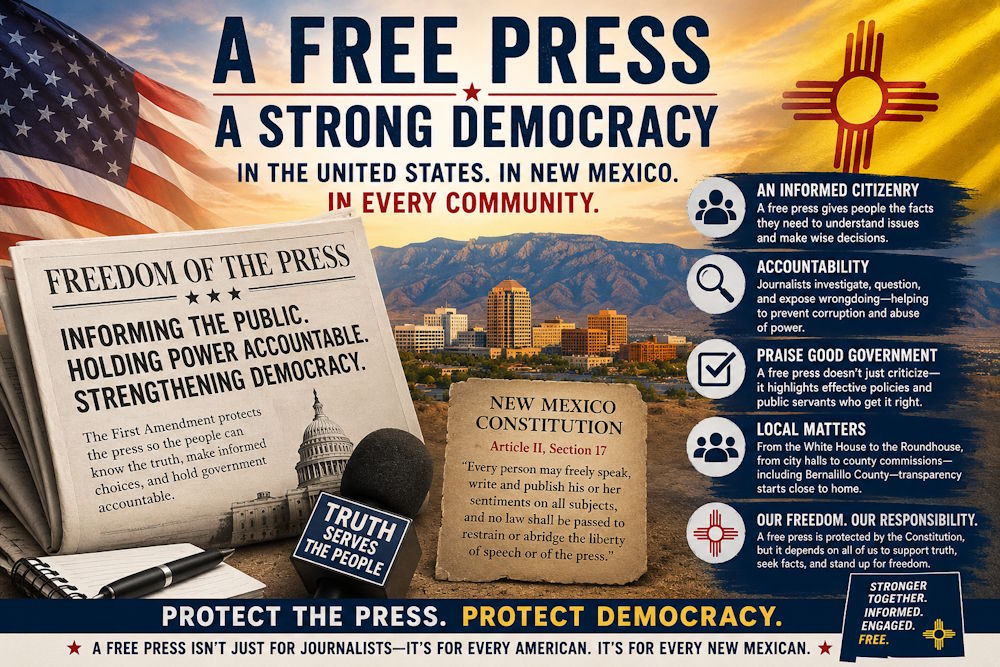
The New Mexico Constitution provides its own protection for freedom of speech and the press. Article II, Section 17 states that every person may freely speak, write and publish his or her sentiments on all subjects, while also providing that no law shall be passed to restrain or abridge the liberty of speech or of the press.
That is a powerful statement.
And it applies to New Mexicans—not just people living in Santa Fe or Albuquerque, and not just large media organizations.
It applies throughout the state.
It applies in our cities and towns.
It applies in our counties.
And it applies right here in Bernalillo County, the state’s most populous county.
Whether the issue involves the federal government, the New Mexico Legislature, the governor, a state agency, a city government, a county commission, a school board or another governmental body, citizens need access to information that allows them to judge the people exercising that public authority.
Government closest to the people can have an enormous effect on everyday life.
County government decisions can affect taxes, public services, public safety, elections, roads, land use and countless other matters.
That makes a free local press every bit as important as a national press.
In fact, there is an argument that local journalism can sometimes be even more important because local government decisions directly affect the people who live in the community.
John F. Kennedy Had Something Important to Say About This
More than six decades ago, President John F. Kennedy gave a remarkable speech about the relationship between government and the press.
On April 27, 1961, Kennedy spoke to the American Newspaper Publishers Association at the Waldorf-Astoria Hotel in New York City.
He called the speech “The President and the Press.”
It is worth reading today:
Read the full JFK Library transcript of “The President and the Press”
You can also listen to the original recording through the John F. Kennedy Presidential Library and Museum:
Listen to JFK’s original audio recording at the JFK Library
Kennedy’s speech was delivered during the Cold War and was heavily influenced by concerns about national security and the recent Bay of Pigs crisis. So some of the circumstances were very different from those we face today.
But many of the principles he discussed are remarkably relevant.
Kennedy Warned Against Government Censorship
One of the most striking things about Kennedy’s speech is that he recognized the tension between government secrecy and a free press.
He acknowledged that legitimate national-security secrets sometimes must be protected.
But he also warned about something equally important: the danger that legitimate claims of security could be expanded into excessive government secrecy.
Kennedy specifically rejected the idea that government officials should use national security as an excuse to censor the press, suppress dissent, conceal mistakes or withhold information the public deserved to know.
That distinction is critical.
There are circumstances where government must protect genuinely sensitive information.
But “national security” should never become a magic phrase that automatically ends public scrutiny.
Kennedy understood that a free society has to wrestle with difficult questions rather than simply giving government officials unlimited authority to decide what the public may know.
Kennedy’s Most Powerful Argument
Perhaps the most important part of the speech was Kennedy’s discussion of the responsibility of the press to inform the American people.
He argued that Americans needed to possess the facts necessary to understand the country’s problems, dangers, choices and opportunities.
And then he made an extraordinarily important observation about the relationship between criticism and democracy.
Kennedy said that no administration and no country can succeed without debate and criticism—and that no republic can survive without them.
That is an idea worth remembering.
Criticism of government is not necessarily disloyalty to government.
Sometimes criticism is exactly what keeps government honest.
Sometimes the person asking the uncomfortable question is doing the country a service.
Sometimes the journalist reporting a government mistake is helping government correct that mistake.
And sometimes the citizen who demands answers is exercising one of the most important responsibilities of citizenship.
Kennedy even made clear that he did not expect the press simply to support his administration. Instead, he wanted the American people to be informed enough to make their own judgments.
That is the essence of self-government.
A Free Press Should Not Be a Government Public-Relations Department
There is another lesson here that deserves attention.
The press should not be an extension of government.
It should not be a public-relations department for elected officials.
But neither should it be an automatic enemy of government.
Its job is something more difficult.
Its job is to report, investigate, question, analyze and inform.
Sometimes that will result in stories government officials appreciate.
Sometimes it will result in stories they strongly dislike.
Both are part of a free society.
A government that only welcomes favorable coverage is not necessarily demonstrating confidence in democracy. A healthy government should be able to withstand questions.
And a healthy press should be willing to ask them.
Why This Matters Today
This principle may be more important today than ever.
Americans receive information from an enormous variety of sources. Newspapers, television stations, radio, websites, social media, podcasts and independent journalists can all play a role in informing the public.
That creates opportunities—but it also creates challenges.
There is misinformation.
There is partisan reporting.
There are sensational headlines.
There are stories that turn out to be wrong.
There are legitimate disagreements about what constitutes reliable journalism.
But none of those problems justify allowing government to become the official referee of political truth.
The answer is for citizens to become better informed—not less informed.
Read more than one source.
Check the facts.
Look at original documents.
Listen to opposing arguments.
Ask questions.
And then make your own judgment.
That is what a free people are supposed to do.
Freedom of the Press Protects Ordinary Citizens
It is easy to think of freedom of the press as something that protects reporters.
But ultimately it protects the reader, the viewer, the listener and the citizen.
A journalist may uncover information, but the reason that information matters is because citizens can use it.
A newspaper investigation might expose corruption.
A television report might reveal government waste.
A local website might discover that a public policy isn’t working as promised.
A county reporter might ask questions about how taxpayer money is being spent.
A citizen journalist might document something that otherwise would never receive public attention.
Those things can make government better.
And when the press reports that a government program is working well, that can make government better too.
Good government deserves recognition.
Bad government deserves scrutiny.
And citizens deserve to know the difference.
From Washington to Bernalillo County
The principles of a free press should not stop at the doors of the White House.
They should not stop at the New Mexico State Capitol.
They belong at city hall.
They belong at the county commission.
They belong at school-board meetings.
They belong wherever public officials exercise authority over the people.
For residents of Bernalillo County, this means that local journalism and local news organizations have an important role in keeping citizens informed about what their county government is doing.
The same principle applies throughout New Mexico.
A citizen in a small rural community has the same fundamental interest in honest information about government as someone living in Albuquerque.
A citizen should not have to depend upon government officials to tell them whether government is performing well.
The people should be able to examine the government for themselves.
And an independent press can help them do that.
The Press Has Responsibilities Too
A free press carries responsibilities along with its constitutional protections.
Journalists should strive for accuracy.
They should distinguish facts from opinion.
They should correct errors.
They should investigate rather than simply repeat government statements.
They should give citizens enough information to understand complicated issues.
And they should resist the temptation to become merely partisan advocates when their responsibility is to inform the public.
But those responsibilities belong to the press itself.
They should not be imposed by government officials who want to silence stories they find embarrassing or politically inconvenient.
That is one of the central lessons of the First Amendment.
The government does not get to decide what the people are allowed to know simply because the government dislikes the story.
Kennedy’s Message Deserves to Be Remembered
John F. Kennedy’s 1961 speech was delivered in a very different America, facing a very different threat.
Yet his central message remains remarkably relevant.
A free society requires an informed public.
An informed public requires access to information.
Access to information requires a press that can investigate and report without government censorship.
And government itself benefits from a press willing to point out its mistakes.
Kennedy understood that the relationship between government and the press would sometimes be uncomfortable.
It is supposed to be.
A free press is not supposed to make government comfortable all the time.
It is supposed to make government accountable.
And that is why the freedom of the press is not simply a right belonging to journalists.
It is a right belonging to the American people.
It belongs to every citizen of the United States.
It belongs to every New Mexican.
And it belongs to every resident of Bernalillo County.
The question is not whether we agree with every story the press publishes.
We won’t.
The question is whether we believe that a free people should have the right to hear those stories, examine the evidence, challenge the reporting, debate the issues and ultimately decide for themselves.
That is what constitutional freedom means.
And if we want our democratic republic to remain strong, we should remember something Kennedy said more than sixty years ago: without debate and criticism, no administration and no country can succeed—and no republic can survive.
A free press does not weaken a free society.
It helps keep one free.